


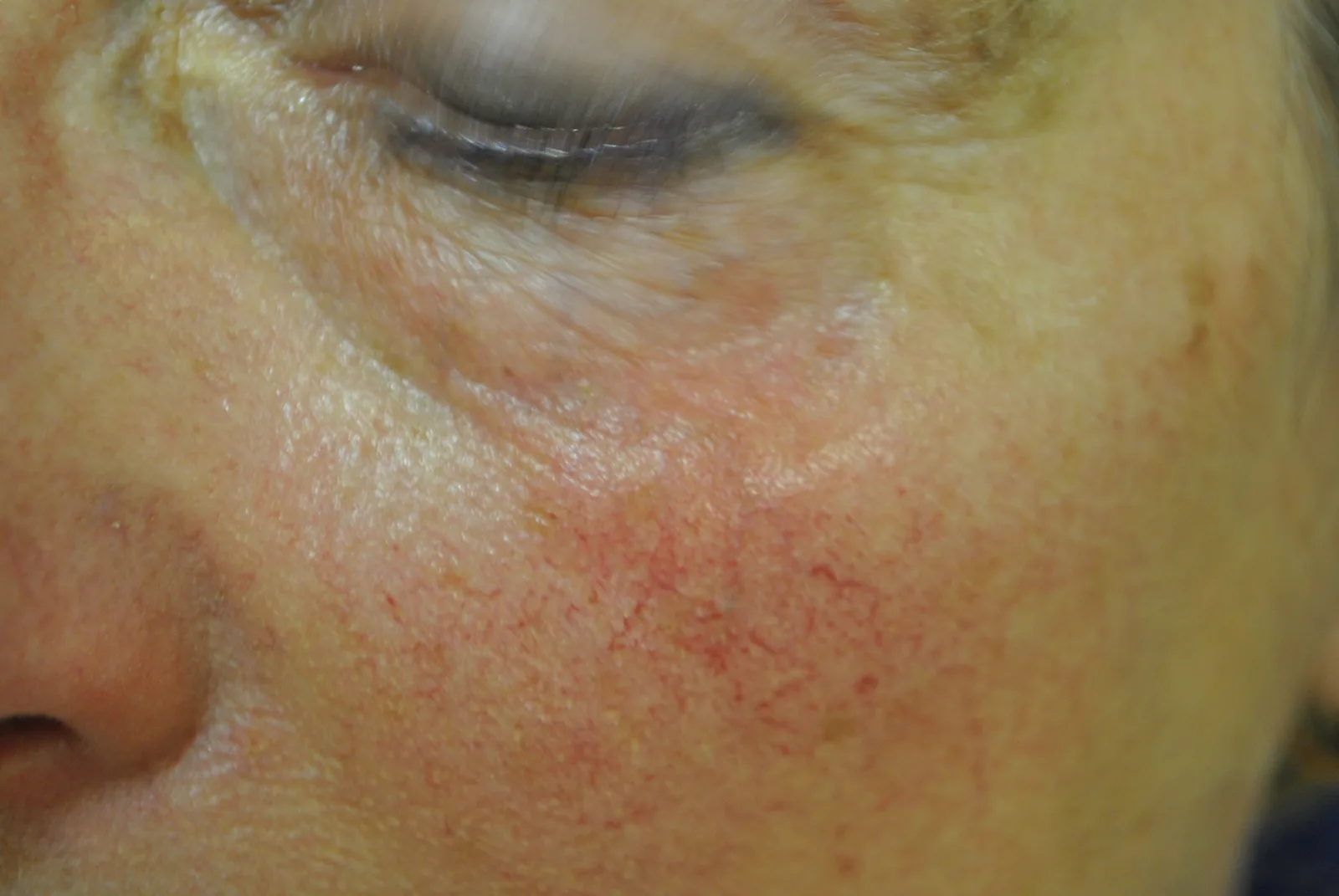
At our CQC-registered dermatology clinic, our consultant dermatologist-led team and experienced laser practitioners assess your skin before any treatment begins. Patients travel to us from across Kent, including Canterbury, Whitstable, Herne Bay, Faversham, Ashford, Folkestone, Dover and Deal, for a plan matched to their skin type.
About the Condition
Thread veins are small, dilated blood vessels that show through the skin as fine red or purple lines. On the face they are most common on the nose, cheeks and around the eyes.
Common features include:
- Fine, red or purple lines visible on the skin's surface
- Most often on the nose, cheeks and around the eyes
- Veins that may look more visible with sun exposure or temperature change
- Skin that appears blotchy or uneven in tone
- Thread veins alongside flushing or redness
They can develop because of genetics, sun exposure, ageing or hormonal changes, or as part of a condition such as rosacea. If you notice persistent redness or flushing as well, our rosacea page explains this in more detail.
Thread veins are not a medical concern in themselves, but it is worth having your skin assessed because visible vessels can be one part of a wider picture, such as rosacea, and treatment planning differs. Age spots and other pigmented marks can also appear alongside thread veins, and these are treated differently. Please note that we treat facial thread veins and do not offer micro-sclerotherapy, the injection treatment for leg veins.
How We Treat It
Treatment always begins with a dermatology consultation and patch test, so that we can confirm the diagnosis and match settings to your skin. Our Consultant Dermatologist, Dr Mark Hudson-Peacock, is the clinic’s Laser Protection Supervisor, and all laser treatment runs under his oversight.
Medical grade laser works by targeting the blood vessels directly, causing them to close and fade from view while the surrounding skin is protected. IPL, or intense pulsed light, is a light based alternative that is often used for fine vessels and for general redness across a wider area. Laser is usually chosen for larger or more clearly defined vessels. Your clinician will advise which suits you after looking at your veins and your skin.
Most people need a short course of sessions, and there may be some temporary redness afterwards, with minimal downtime. Good sun protection and gentle skincare can help reduce the chance of new thread veins forming. Individual results vary, and new vessels can appear over time. Your practitioner will explain how many sessions to expect, how far apart they are spaced, and how to look after your skin between visits, including avoiding sunbeds and using a daily sunscreen.
When to See a Specialist
Thread veins are a cosmetic rather than a medical concern, so there is no urgency to seek treatment. You may wish to book a consultation if they bother you, if they are spreading, or if they are affecting your confidence.
It is also worth being assessed if thread veins appear alongside persistent redness, flushing or acne-like spots, since this may point to rosacea, which can need a broader treatment approach.
Further reading: NHS – Varicose veins · DermNet – Telangiectasia · British Association of Dermatologists
Frequently Asked Questions
Are thread veins dangerous?
No, they are harmless and are a cosmetic concern. Treatment is a matter of personal preference rather than medical necessity.
What causes thread veins?
Common causes include genetics, sun exposure, ageing and hormonal changes. They can also develop as part of rosacea.
How is thread vein treatment carried out?
Medical grade laser or IPL targets the visible blood vessels directly, causing them to close over a short course of sessions. A consultation and patch test always come first.
Will thread veins come back after treatment?
The treated veins should not return, though new ones can develop over time, particularly with continued sun exposure or if an underlying condition such as rosacea is not managed. Individual results vary.
Can I prevent new thread veins forming?
Good sun protection and gentle skincare can help reduce the chance of new thread veins, though genetics also play a significant role.
Can you treat thread veins on the legs?
We treat facial thread veins with laser and IPL. We do not offer micro-sclerotherapy, the injection treatment for leg veins.
Get your concern assessed
First step
Dermatology Consultation £250, Patch Test £50
Appointment
30 minutes
Availability
Usually within 1 to 2 weeks
Treatments for thread veins

Related conditions
Posted on Google
 David Manyweathers
Trustindex verifies that the original source of the review is Google.
I would like to say that every aspect of my operation and after treatment was absolutely first class, would definitely recommend The Skin and Laser.Posted on Google Toby LambI had my skin tag removal done by Amber and I honestly couldn’t be happier with the experience. Amber was so lovely, professional and reassuring throughout the whole process, making me feel completely comfortable and at ease. She took the time to explain everything and made the treatment feel quick and straightforward. I’m so pleased with the service I received and would highly recommend Amber to anyone considering skin tag removal.Posted on Google
 brooke etheridgeI had a cyst removed from my cheek, dr mark was so confident and reassuring, the procedure was clearly explained and efficiently carried out I was back to normal duties within an hour! Thank you!Posted on Google
 Pam FrostExcellent experience in every way. So glad I found this place. The treatment by Charlotte was exceptional. Update. Second visit was just as good as the first.