


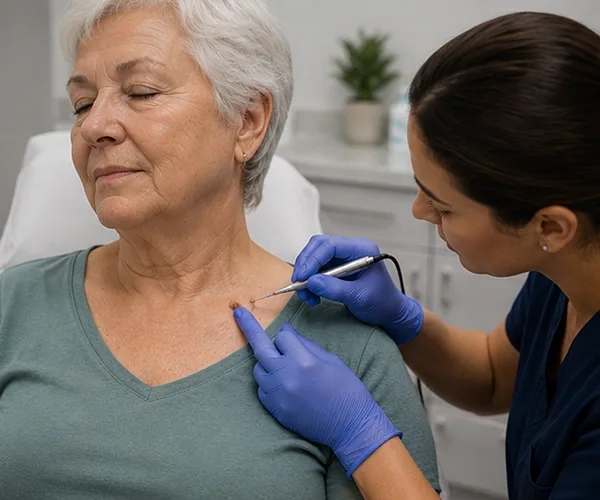
At our CQC-registered dermatology clinic, our consultant dermatologist-led team can confirm that a growth really is a skin tag and offer removal with our therapist team or our doctor. Patients travel to us from across Kent, including Canterbury, Whitstable, Herne Bay, Faversham, Ashford, Folkestone, Dover and Deal, for quick, straightforward treatment.
About the Condition
Skin tags are small, soft growths that often hang from a narrow stalk. They commonly appear around the neck, armpits, eyelids, groin and other body folds, where skin rubs against skin or clothing.
Common features include:
- A small, soft growth, sometimes on a narrow stalk
- Skin coloured or slightly darker than the surrounding skin
- Most often around the neck, armpits, eyelids and groin
- Catching on clothing, necklaces or during shaving
- New tags appearing gradually over time
Skin tags become more common with age and are more likely if you carry extra weight or have a family history of them. Friction is thought to play a part. They are harmless and are not related to skin cancer.
Skin tags are usually easy to recognise, but other growths such as moles, warts or seborrhoeic keratoses can look similar. Confirming what a growth is before it is removed means you are always treated for the right thing. Our pages on seborrhoeic keratosis and sebaceous cysts cover two other common benign growths. If you have a lot of skin tags, or they keep returning, mention this at your appointment so we can advise you sensibly on what to expect and which method suits each area.
How We Treat It
Treatment is a matter of preference, since skin tags do not harm your health. If you are unsure about a growth, a Dermatology Consultation is the place to start. For clearly identified skin tags, we offer two removal methods, chosen according to the size and number of your tags.
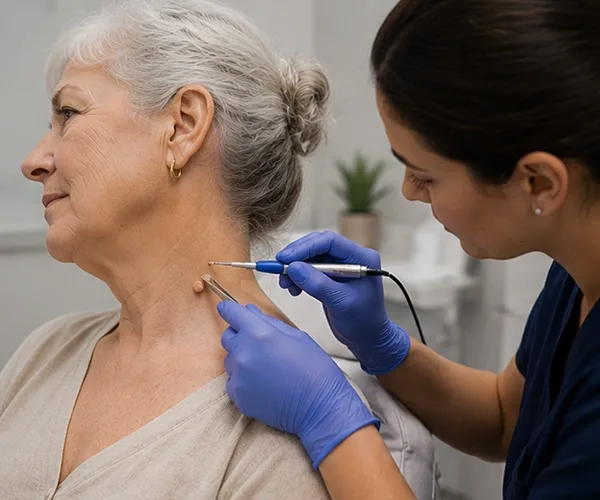
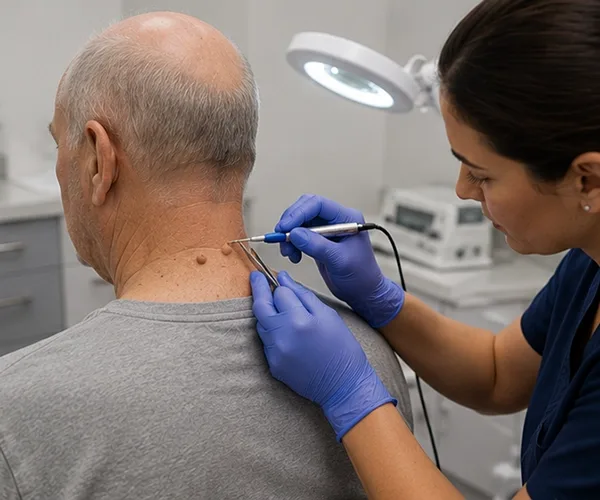
Smaller tags are usually removed with electrolysis by our therapist team, a quick treatment with little to no downtime. Larger tags may be better suited to snip cautery carried out by our doctor under local anaesthetic, which is also a short procedure with minimal downtime. Both methods aim to leave the skin healing cleanly, and snip cautery on a larger tag may leave a very small mark that fades over time. Individual results vary.
Please avoid cutting or tying off skin tags at home, as this can cause bleeding and infection. If you also have other lumps, our cyst removal service treats sebaceous cysts and other benign lumps.
When to See a Specialist
Skin tags are almost always straightforward to identify, but it is worth having any growth assessed if you are unsure what it is. This is especially true if it changes in appearance, becomes painful, or starts to bleed without an obvious cause such as catching on clothing.
Book a consultation if you have a growth that looks different from your other skin tags, is darker or has an irregular colour, or is not the soft, skin coloured growth described above. If a growth bleeds repeatedly or changes quickly, please have it checked without delay, or call us for a swift appointment.
Further reading: NHS – Skin tags · DermNet – Skin tag · British Association of Dermatologists
Frequently Asked Questions
Are skin tags dangerous?
No, they are harmless and are not linked to skin cancer. Removal is a matter of comfort or personal preference.
Can I remove a skin tag myself at home?
This is not recommended. Home removal can lead to bleeding, infection or an uneven result, whereas professional removal in the clinic is quick and clean.
Will skin tags come back after removal?
The treated tags should not return, though new ones can develop elsewhere over time, particularly in the same general areas.
Which removal method is right for me?
This depends on the size of your skin tags. Smaller tags are usually suited to electrolysis, while larger ones may be better treated with snip cautery. Our team will advise at your appointment.
Does skin tag removal leave a scar?
Both methods are designed to minimise any mark, and most people see the treated area heal cleanly. Snip cautery on a larger tag may leave a very small mark that fades over time.
Do I need a GP referral?
No. You can book directly with us, online or by phone.
Get your concern assessed
First step
Electrolysis with a therapist £50 (1 to 5 lesions), or snip cautery with a doctor £260 (1 to 5 lesions)
Appointment
30 minutes
Availability
Usually within 1 to 2 weeks
Treatments for skin tags

Related conditions
Posted on Google
 David Manyweathers
Trustindex verifies that the original source of the review is Google.
I would like to say that every aspect of my operation and after treatment was absolutely first class, would definitely recommend The Skin and Laser.Posted on Google Toby LambI had my skin tag removal done by Amber and I honestly couldn’t be happier with the experience. Amber was so lovely, professional and reassuring throughout the whole process, making me feel completely comfortable and at ease. She took the time to explain everything and made the treatment feel quick and straightforward. I’m so pleased with the service I received and would highly recommend Amber to anyone considering skin tag removal.Posted on Google
 brooke etheridgeI had a cyst removed from my cheek, dr mark was so confident and reassuring, the procedure was clearly explained and efficiently carried out I was back to normal duties within an hour! Thank you!Posted on Google
 Pam FrostExcellent experience in every way. So glad I found this place. The treatment by Charlotte was exceptional. Update. Second visit was just as good as the first.