


At our CQC-registered dermatology clinic, our consultant dermatologist-led team examines pigmented marks carefully before any treatment is considered. Patients travel to us from across Kent, including Canterbury, Whitstable, Herne Bay, Faversham, Ashford, Folkestone, Dover and Deal, for a clear diagnosis and a plan that suits them.
About the Condition
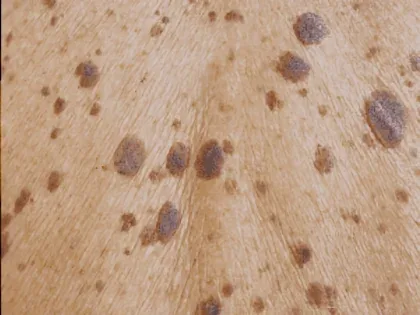
Pigmented lesions is a broad term rather than a single diagnosis. It covers flat marks that look darker than the surrounding skin, including sun spots (see our page on age spots), freckles, café au lait marks and other benign pigmented marks.
Common features include:
- Flat, brown or tan coloured marks
- Marks present from birth, or appearing gradually over time
- Marks that darken with sun exposure
- A new mark that has appeared recently
- A mark you have noticed changing in size, shape or colour
Many pigmented lesions are linked to sun exposure over the years, while others are simply part of a person’s skin type or are present from birth. Pigmentation can also be caused by hormonal changes, as in melasma, which needs a different approach.
Because a small number of skin cancers can look like a pigmented mark, and because harmless marks can look similar to one another, an accurate diagnosis from a dermatology specialist is the essential first step. It tells you whether a mark can safely be left alone, treated for appearance, or needs a closer look.
How We Treat It
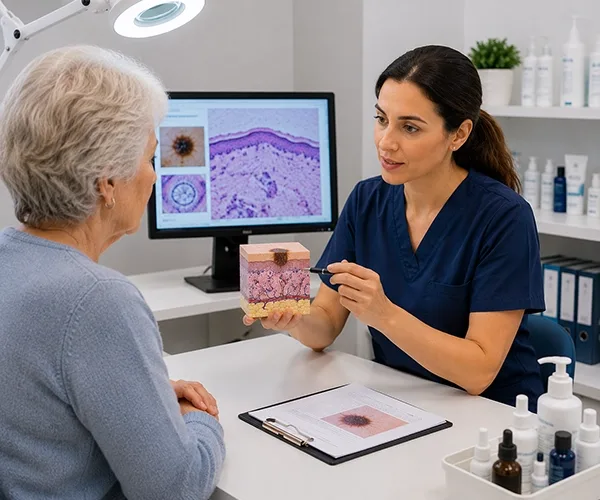
Every assessment begins with a close examination by one of our Consultant Dermatologists, often using dermoscopy, a magnified view of the skin. If you have several marks or a lot of moles, our mole check and mole mapping services offer a wider review of your skin.
Once a mark has been confirmed as benign, it can often be treated cosmetically with medical laser or IPL to reduce its appearance, particularly for sun related marks. Our Consultant Dermatologist, Dr Mark Hudson-Peacock, is the clinic’s Laser Protection Supervisor, and every course starts with a consultation and patch test so that settings are matched to your skin. Individual results vary.
Any mark with features that raise concern is handled differently. Rather than being treated for appearance, it is removed and sent for histology, which confirms the diagnosis under the microscope.
When to See a Specialist
Any new pigmented mark, or one that is changing in size, shape or colour, should be assessed by a clinician before you consider cosmetic treatment. You should also book promptly if a mark itches, bleeds, crusts or looks different from your other marks.
If you have a mark that is changing quickly, or that is bleeding or not healing, do not wait for a routine appointment. Book with us for a rapid assessment, and call us for a swift appointment. Marks that have looked the same for years and are not bothering you are usually no cause for concern, but you are always welcome to have them checked for reassurance.
Further reading: NHS – Moles · DermNet – Pigmented skin lesions · British Association of Dermatologists
Frequently Asked Questions
Are all pigmented lesions harmless?
Most are, but a small number of skin cancers can appear as a pigmented mark. This is why a proper assessment matters, particularly for anything new or changing.
Can pigmented lesions be treated with laser straight away?
Only once they have been assessed and confirmed as benign. Any lesion with concerning features is removed and sent for histology instead of being treated cosmetically.
What is the difference between a pigmented lesion and a mole?
Pigmented lesions are generally flat, while moles can be flat or raised and are made up of clusters of pigment cells. Both need careful assessment if they are new or changing.
How is a pigmented lesion assessed?
Our team examines the mark closely, often using dermoscopy, to decide whether it can be treated cosmetically or needs removal for histology.
Can I have several pigmented lesions treated at once?
Often, yes, once each has been individually assessed and confirmed suitable. Your clinician will advise what can reasonably be treated in a single session.
Do I need a GP referral?
No. You can book directly with us online or by phone, with no GP referral needed.
Get your concern assessed
First step
Consultant Dermatologist £300
Appointment
30 minutes
Availability
Usually within 1 to 2 weeks
Treatments for pigmented lesions

Related conditions
Posted on Google
 David Manyweathers
Trustindex verifies that the original source of the review is Google.
I would like to say that every aspect of my operation and after treatment was absolutely first class, would definitely recommend The Skin and Laser.Posted on Google Toby LambI had my skin tag removal done by Amber and I honestly couldn’t be happier with the experience. Amber was so lovely, professional and reassuring throughout the whole process, making me feel completely comfortable and at ease. She took the time to explain everything and made the treatment feel quick and straightforward. I’m so pleased with the service I received and would highly recommend Amber to anyone considering skin tag removal.Posted on Google
 brooke etheridgeI had a cyst removed from my cheek, dr mark was so confident and reassuring, the procedure was clearly explained and efficiently carried out I was back to normal duties within an hour! Thank you!Posted on Google
 Pam FrostExcellent experience in every way. So glad I found this place. The treatment by Charlotte was exceptional. Update. Second visit was just as good as the first.