


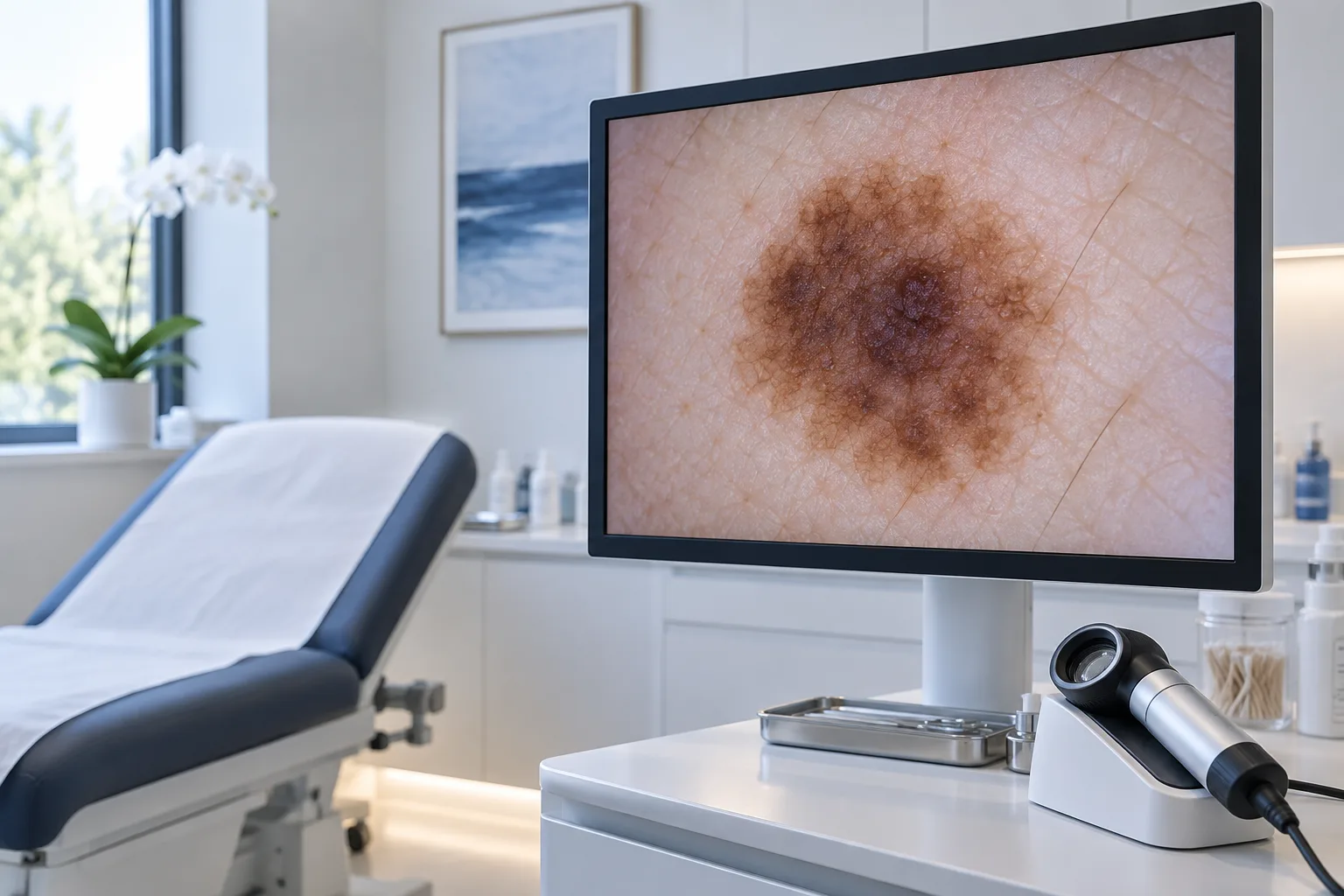
At our CQC-registered dermatology clinic, our Consultant Dermatologists assess moles and skin lesions and offer a rapid access pathway for concerns. We welcome patients from across Kent, including Canterbury, Whitstable, Herne Bay, Faversham, Ashford, Folkestone, Dover and Deal. We will explain any findings clearly.
About the Condition
Melanoma can develop anywhere on the body, including areas that are not usually exposed to the sun. It can appear as a new mark or as a change in an existing mole. Most moles are harmless, and only a clinician can tell you whether a particular mole needs attention.
Changes worth having checked include:
- A new mole that looks different from your others
- A mole that is changing in size, shape or colour
- One half of a mole looking different from the other half
- An irregular, blurred or notched border
- More than one colour within the same mole, such as brown, black, red or blue
- A mole that is larger than about 6mm across, or that itches, crusts or bleeds
These features are often summarised as the ABCDE checklist. Having one does not mean you have melanoma, but the mole should be examined.
Risk factors include fair skin, a history of sunburn, a large number of moles and a family history of melanoma.
Accurate diagnosis matters because melanoma can look like other conditions, such as an ordinary mole or a seborrhoeic keratosis, and other lesions can look like melanoma. Only examination, and where needed removal and laboratory analysis (histology), can confirm what a lesion is. Our page on changing moles and our pigmented lesions page explain more.
How We Treat It
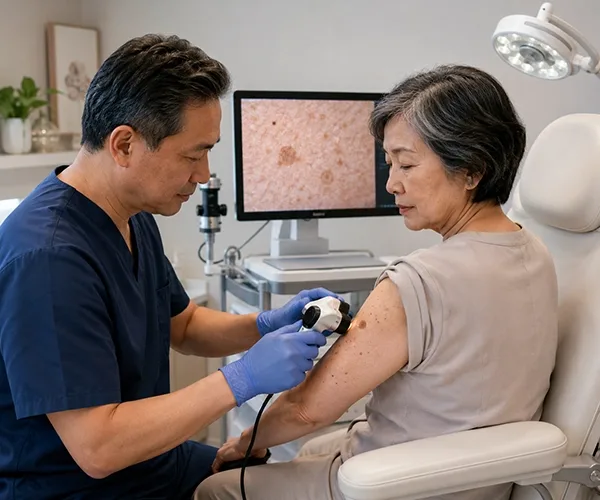
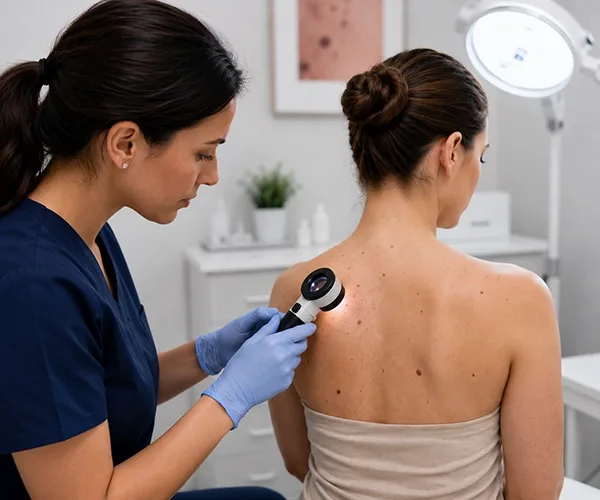
Your appointment begins with an assessment by one of our Consultant Dermatologists, who examines your skin and any moles you are concerned about using dermoscopy, a specialised magnified examination. If a lesion looks unusual, it can be removed and sent for histology, which confirms the diagnosis and shows how deep any melanoma has grown. This guides what happens next.
Removal is carried out here in clinic under local anaesthetic, so you can go home the same day. Histology is included as standard. Depending on the result, some people need no further treatment, while others are advised to have a wider excision, which is usually also done here. Occasionally we may advise referral to a wider specialist team, and we will explain why. Individual results vary.
If you have many moles or a higher risk, our mole mapping service provides photographic monitoring over time.
When to See a Specialist
Please arrange assessment without delay for any new or changing mole, or one with the features listed above. Do not wait to see whether it settles on its own. We offer rapid access appointments, often within days for urgent concerns, and you do not need a GP referral to see us.
Please seek prompt medical advice if a mole or lesion bleeds, becomes sore or ulcerated, or grows quickly, and call us for a swift appointment.
Regular self-checks of your skin help changes to be picked up early.
Further reading: NHS – Melanoma skin cancer · DermNet – Melanoma · British Association of Dermatologists
Frequently Asked Questions
How is melanoma diagnosed?
A suspicious mole is examined using dermoscopy and, where appropriate, removed and sent for histology. This confirms the diagnosis and shows how the lesion has grown.
Is melanoma curable?
Many melanomas found early can be treated successfully with surgery. Outcomes depend on the individual and on how deep the melanoma has grown, which is why prompt assessment of a changing mole matters.
How quickly can I be seen if I am worried about a mole?
We offer a rapid access pathway, so you can usually be assessed by one of our Consultant Dermatologists within days.
Will I need further treatment after the mole is removed?
That depends on the histology result. Some patients need no further treatment, while others need a wider excision, usually carried out here at the clinic. Your Consultant Dermatologist will explain the result clearly.
Am I at higher risk of melanoma?
Risk factors include fair skin, a history of sunburn, a large number of moles and a family history of melanoma. If any of these apply, regular mole checks or mapping are worth discussing with your Consultant Dermatologist.
Do you accept private medical insurance?
Yes, we accept all major private medical insurers.
Get your concern assessed
First step
Dermatology Consultation, £300
Appointment
30 minutes
Availability
Rapid access, often within days for urgent concerns
Consultant Dermatologist appointments are booked by phone or email, so we can check whether you are insured or self-funding.
Treatments for melanoma

Related conditions
Posted on Google
 David Manyweathers
Trustindex verifies that the original source of the review is Google.
I would like to say that every aspect of my operation and after treatment was absolutely first class, would definitely recommend The Skin and Laser.Posted on Google Toby LambI had my skin tag removal done by Amber and I honestly couldn’t be happier with the experience. Amber was so lovely, professional and reassuring throughout the whole process, making me feel completely comfortable and at ease. She took the time to explain everything and made the treatment feel quick and straightforward. I’m so pleased with the service I received and would highly recommend Amber to anyone considering skin tag removal.Posted on Google
 brooke etheridgeI had a cyst removed from my cheek, dr mark was so confident and reassuring, the procedure was clearly explained and efficiently carried out I was back to normal duties within an hour! Thank you!Posted on Google
 Pam FrostExcellent experience in every way. So glad I found this place. The treatment by Charlotte was exceptional. Update. Second visit was just as good as the first.