


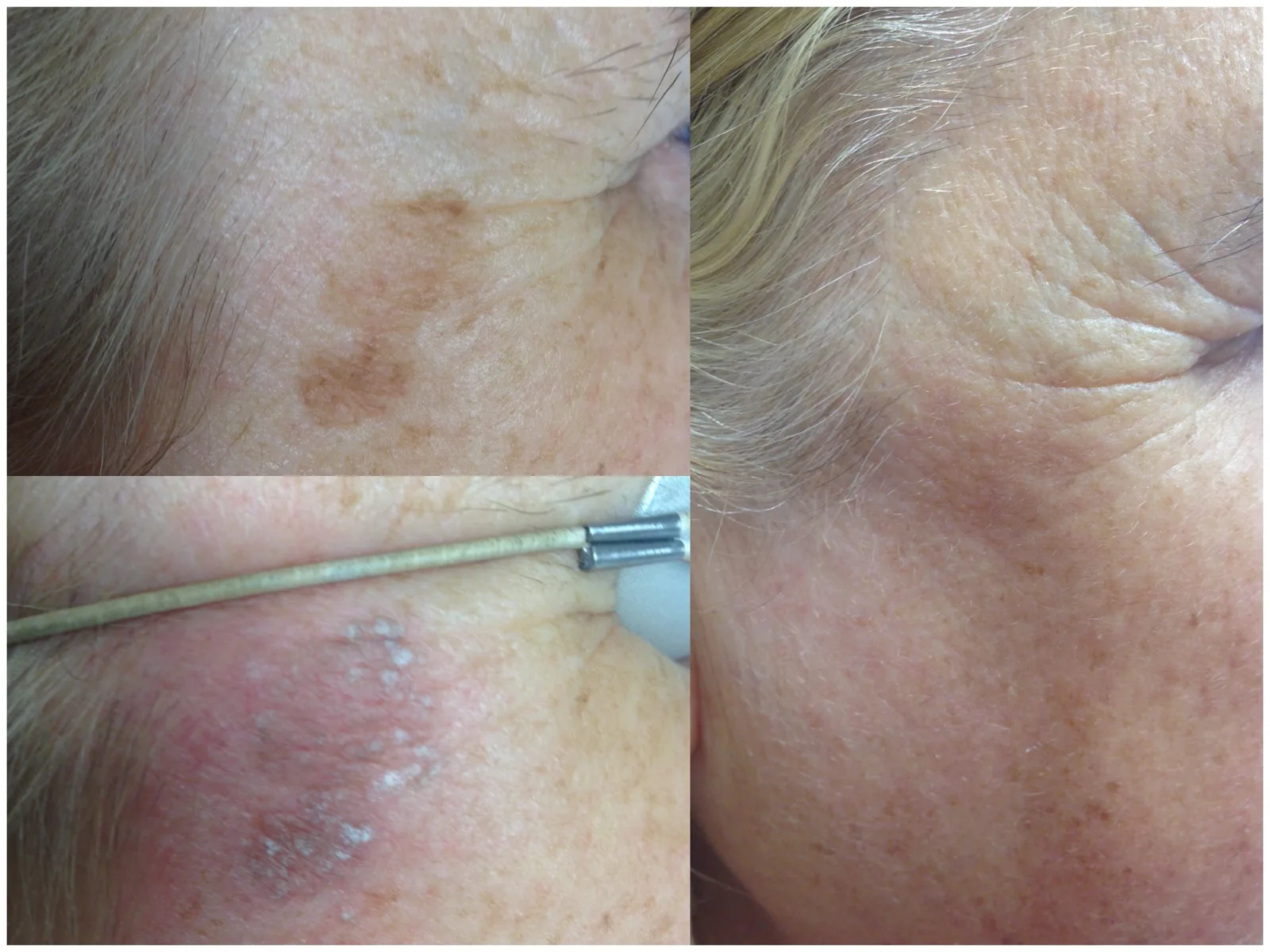
At our CQC-registered dermatology clinic, every mark is checked before it is treated, under the oversight of our Consultant Dermatologist, Dr Mark Hudson-Peacock, who is also our Laser Protection Supervisor. Patients travel to us from across Kent, including Canterbury, Whitstable, Herne Bay, Faversham, Ashford, Folkestone, Dover and Deal. Our aim is to confirm what the mark really is and, where appropriate, recommend a treatment plan matched to your skin.
About the Condition
Age spots, also known as sun spots or liver spots, are flat, brown or tan marks that develop on skin that has had significant sun exposure over the years. They most commonly appear on the face, hands, shoulders and chest, and become more common as we get older.
Typical features include:
- Flat, brown or tan marks on sun-exposed skin
- Marks that may darken further with more sun exposure
- A gradual increase in number with age
- No pain, itching or change in skin texture
Cumulative sun exposure is the main cause, which is why age spots appear on the areas most exposed to the sun throughout life. Age spots themselves are harmless, but other pigmented marks can look similar. Regular sunscreen use and covering up in strong sunlight can help stop existing spots darkening further.
That is why an accurate diagnosis matters. A new or changing mark should be assessed to confirm that it is an age spot rather than something needing closer attention, such as a changing mole or another pigmented lesion. Age spots are also different from melasma and other forms of hyperpigmentation, which need a different approach.

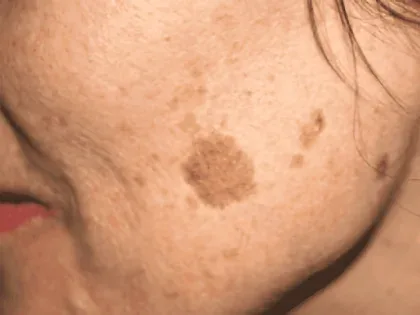
How We Treat It
Treatment starts with a consultation and patch test, so we can confirm the diagnosis and check that treatment is suitable for your skin type. Our Dermatology Consultation is the first step where a mark needs a closer look.
We use medical-grade laser and IPL systems, with settings matched to your skin at your patch test. Laser or IPL targets the excess pigment directly. The spot darkens slightly and then flakes away naturally over 1 to 2 weeks. Most age spots respond within 1 to 3 sessions, spaced 4 to 6 weeks apart, depending on their size and how established they are. Our Age Spot Removal treatment focuses on individual marks, while our Pigmentation Treatment page covers a broader approach where age spots appear alongside other pigmentation. Individual results vary.
Good sun protection afterwards helps maintain your results and reduces the chance of new spots forming. Your practitioner will talk you through aftercare at your appointment.
When to See a Specialist
Age spots are a cosmetic concern rather than a medical one, but it is worth having any new mark assessed first. A specialist can confirm that it is genuinely an age spot and not something needing closer attention.
Book an appointment if a mark is new, growing, changing colour or shape, has an uneven border, itches or bleeds, or looks different from your other marks. In that case our mole check or mole mapping service may be more appropriate. Please seek prompt medical advice if a mark is bleeding or changing quickly.
Further reading: DermNet – Solar lentigo (age spots) · British Association of Dermatologists
Frequently Asked Questions
Are age spots dangerous?
No, age spots themselves are harmless and are caused by sun exposure over time. Any new or changing mark is still worth having checked to confirm the diagnosis.
What causes age spots?
Cumulative sun exposure over the years is the main cause, which is why they typically appear on the face, hands and chest, the areas most exposed to the sun.
How is age spot treatment carried out?
Medical-grade laser or IPL targets the excess pigment directly. The spot darkens slightly before flaking away naturally over 1 to 2 weeks.
How many sessions will I need?
Most age spots respond within 1 to 3 sessions, spaced 4 to 6 weeks apart, depending on their size and how established they are. Individual results vary.
Can age spots be prevented?
Daily sun protection is an important way to reduce the chance of new age spots forming, alongside avoiding excessive sun exposure.
Why do I need a patch test?
A patch test lets us check how your skin responds so that laser or IPL settings can be matched to your skin type before a full course begins.
Get your concern assessed
First step
Specialty Doctor £250, Consultant Dermatologist £300
Appointment
30 minutes
Availability
Usually within 1 to 2 weeks
Treatments for age spots

Related conditions
Posted on Google
 David Manyweathers
Trustindex verifies that the original source of the review is Google.
I would like to say that every aspect of my operation and after treatment was absolutely first class, would definitely recommend The Skin and Laser.Posted on Google Toby LambI had my skin tag removal done by Amber and I honestly couldn’t be happier with the experience. Amber was so lovely, professional and reassuring throughout the whole process, making me feel completely comfortable and at ease. She took the time to explain everything and made the treatment feel quick and straightforward. I’m so pleased with the service I received and would highly recommend Amber to anyone considering skin tag removal.Posted on Google
 brooke etheridgeI had a cyst removed from my cheek, dr mark was so confident and reassuring, the procedure was clearly explained and efficiently carried out I was back to normal duties within an hour! Thank you!Posted on Google
 Pam FrostExcellent experience in every way. So glad I found this place. The treatment by Charlotte was exceptional. Update. Second visit was just as good as the first.